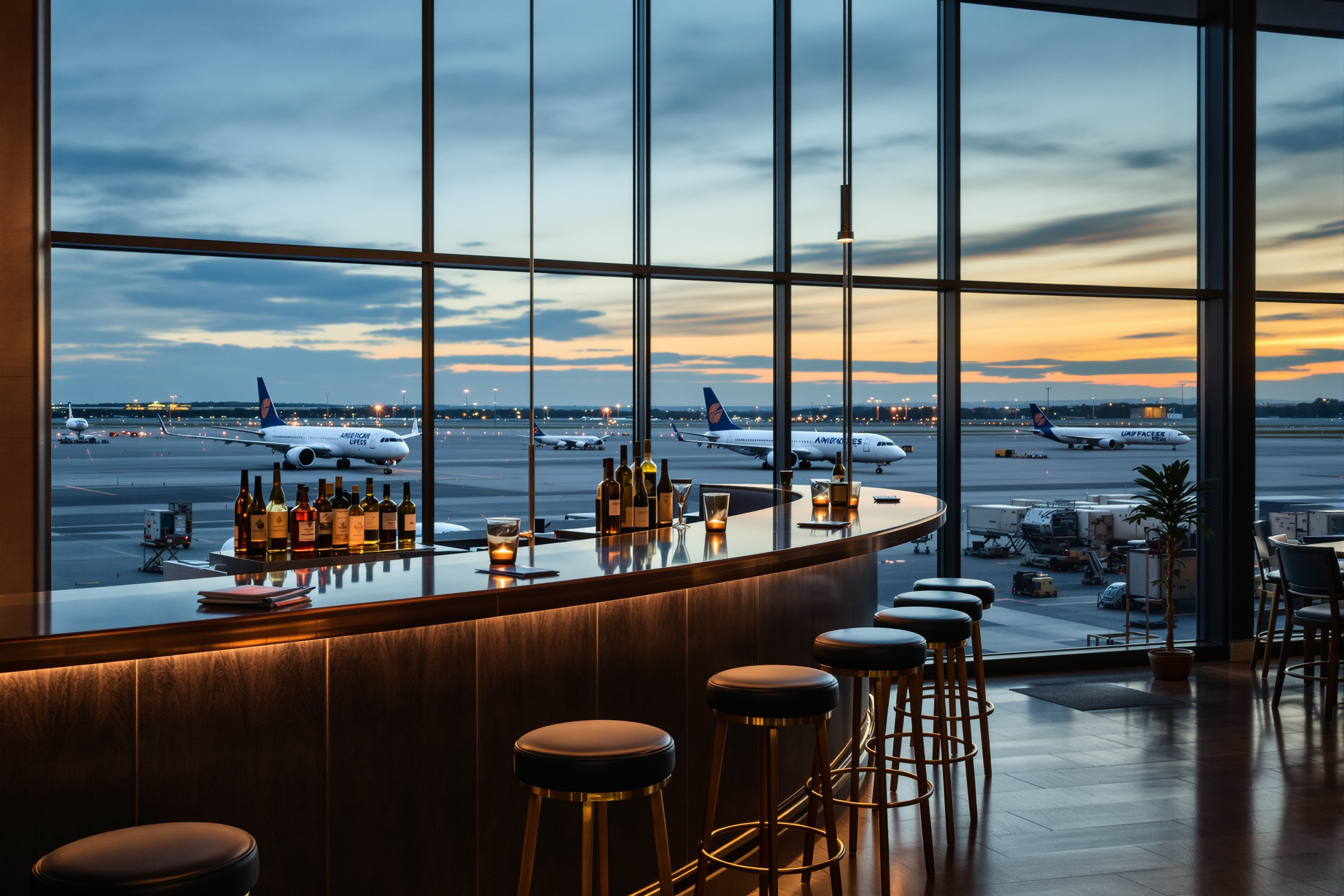
American Express opened the Centurion Lounge at Hartsfield-Jackson Atlanta International Airport on February 14, 2024, on Concourse E near Gate E11, at approximately 26,000 square feet — the largest Centurion in the network at the time of opening, and roughly 11,000 square feet larger than the bi-level JFK flagship. The lounge carries a two-bar configuration (a main bar with a 10-wine list curated by Anthony Giglio, and the Reserve by American Express whiskey bar), three outdoor terraces (a first within the Centurion network), and a Southern-leaning food program from James Beard semifinalist chef Deborah VanTrece. For corporate travelers on the Atlanta hub, it is the only large-footprint network-card lounge in the airport and the most credible counterweight to Delta Sky Club volume in Concourse E.
American Express opened the Centurion Lounge at Hartsfield-Jackson Atlanta International Airport on February 14, 2024, in a roughly 26,000-square-foot footprint on Concourse E near Gate E11. The opening was, on size alone, the most consequential single Centurion build in the network’s history — the new lounge displaced the bi-level JFK Terminal 4 location as the largest Centurion globally by approximately 11,000 square feet, and arrived at the world’s busiest airport at a moment when American Express’s premium card strategy was visibly recalibrating around capacity rather than around access expansion. Two years on, with the 2023 three-hour-window access reform now fully bedded in and the post-2024 Platinum fee structure stable, the Atlanta lounge is the network’s de facto flagship. It is also the lounge that defines, for most U.S. corporate programs, what the Platinum Card actually buys on the ground at the single most-trafficked U.S. hub.
This is a retrospective procurement read of the lounge as it operates in mid-2026. It is not a connoisseur review. It is an analyst landscape for travel managers and corporate principals who are building 2026–2027 card programs and need to know what the Centurion Lounge ATL is, what it is not, and how it stacks against the other premium-lounge options on the Atlanta airfield — principally Delta’s Sky Club network, distributed across six concourses, which remains the dominant lounge presence at Hartsfield-Jackson and the reference point against which any other premium lounge product in the airport is measured.
What’s Actually There
The lounge occupies the upper level of Concourse E near Gate E11, post-security, and is accessible from any concourse via the Plane Train inter-concourse automated people mover. The footprint is approximately 26,000 square feet, which is large enough that the room subdivides into recognizable zones rather than reading as a single open floor: a main dining area anchored by an open kitchen, a separate seated dining room, a buffet-style food and beverage line that runs the length of the central spine, a quiet workroom, family-oriented seating, a shower suite cluster with L’Occitane bath amenities, and three outdoor terraces.
The outdoor terraces are the architectural signature of the build and remain, two years after opening, a network first that has not been replicated at any subsequent Centurion location. There are three of them: one with a direct runway view, one landscaped as a sheltered courtyard, and one configured as a more functional smoker-free open-air seating area. All three are equipped with overhead heaters and fans for year-round use. The runway terrace is the one that fills first at peak banks; the courtyard terrace is the quietest seated workspace in the lounge on most weekday mornings.
The interior design references Atlanta’s self-description as “the city in the forest.” A roughly 3,850-square-foot suspended light sculpture in the central spine evokes a forest canopy. A 50-year-old olive tree anchors the main dining area. A 60-foot mural by an Atlanta-based artist runs along one of the dining walls. These are the kinds of design moves that would be easy to dismiss as decorative — and they are decorative — but the cumulative effect is that the room reads as deliberately Atlanta-specific rather than as a network-template buildout dropped into a Concourse E shell. That distinction matters less for the lounge product itself than for what it signals about Amex’s approach to the flagship: the Atlanta build was treated as a flagship build, not as a scaled-up replication of the Phoenix or Denver footprint.
The food program is led by chef Deborah VanTrece, a former flight attendant and James Beard semifinalist whose Atlanta restaurant portfolio includes Twisted Soul Cookhouse & Pours, Oreatha’s at the Point, and La Panarda. The menu is locally anchored and Southern-inflected, with rotating items that have included black-eyed pea biryani, za’atar grilled chicken thighs with green tomato chimichurri, and a twisted soul salad with strawberry peppercorn vinaigrette. This is a more locally specific food posture than the rotating chef-collaborative model at the DFW or LAX Centurions, both of which have leaned more on national chef rotations and less on a single Atlanta-anchored culinary identity. For the food program alone, the Atlanta Centurion is a credible destination — an unusual claim for any U.S. airport lounge, where the food typically functions as adequate-against-flight-cancellation rather than as a draw in its own right.
The beverage program splits across two bars. The main bar carries a 10-wine list curated by Centurion Lounge wine director Anthony Giglio, plus a rotating cocktail and beer offering anchored on regional craft selections including Wild Heaven Beer of Atlanta. The Reserve by American Express whiskey bar is the more interesting product: a separate footprint with more than twenty whiskeys, a cocktail list designed by Centurion mixologist Jim Meehan, and a different seated-bar configuration that functions as a lounge-within-the-lounge. The dedicated whiskey bar format is shared only with a handful of other Centurion locations and is one of the elements that materially distinguishes the Atlanta lounge from the rest of the network.
Coffee is handled in partnership with Atlanta-local Rev Coffee Roasters — a roastery rather than a chain — and is served at a dedicated coffee station rather than through the main bar. For corporate travelers on early-morning Atlanta departures, the coffee program is functionally on par with what a serious independent cafe in the city would produce, which is a non-trivial differentiator against the network-template espresso machines that anchor most U.S. airport lounges.
Wi-Fi is password-protected and fast — adequate for video calls in the work zones, though as with most U.S. airport lounges the audio environment in the main dining area is not configured for sustained business conversations. Shower suites are stocked with the network-standard L’Occitane amenity kit and are bookable on arrival rather than reservable in advance. At peak banks, shower-suite wait times in the 10–20 minute range are typical and have not been materially compressed since opening.
Access Policy
Access requires three things in combination, with no exceptions in standard operating practice. First, a same-day boarding pass for a flight departing within three hours of the cardholder’s arrival at the lounge — the three-hour-window rule introduced in February 2023 as part of Amex’s network-wide capacity reform, and applied uniformly at every Centurion location since. Second, an eligible Amex credential: The Platinum Card from American Express, The Business Platinum Card from American Express, the Centurion charge card, or the Delta SkyMiles Reserve American Express Card. Third, a physical or digital card presentation; the cardholder must be present and credentialed in person, which is the rule that closed the secondary-card access workaround that had existed before the 2023 reforms.
Authorized users on Platinum and Business Platinum accounts have not been admitted as independent cardholders since the February 2023 reform — a change that materially affected corporate programs that had previously routed lounge access through low-cost authorized-user issuance as an alternative to issuing full Platinum cards across the flyer base. The basic cardholder can still bring guests, but the guest entitlement now depends on the cardholder’s recent spend tier under the post-2023 framework: cardholders meeting the higher spend threshold retain a more generous guest allowance, while cardholders below the threshold operate under a tightened paid-guest model. For corporate travel managers, the practical implication is that the 2026 card program math now requires a full Platinum or Business Platinum issuance per traveler rather than a single primary card with authorized users — a fee delta that the Centurion ATL access alone does not justify, but that the combined Platinum credit-and-lounge stack typically does for any flyer with material Atlanta volume.
The Delta SkyMiles Reserve American Express Card is the alternative credential pathway, and the most common one among Atlanta-based corporate travelers given Delta’s hub dominance at the airport. Reserve access to the Centurion ATL requires a same-day Delta-marketed boarding pass and is in addition to the cardholder’s Delta Sky Club access — meaning a Reserve cardholder on a Delta itinerary out of Atlanta has a wider lounge option set than a Platinum cardholder on a non-Delta itinerary. This is a deliberate Amex-Delta co-marketing structure that has held stable through the 2024–2025 card refresh cycle and remains the most efficient single-card credential for Atlanta-based Delta flyers.
The access policy is not configured to admit non-Amex credentials. Priority Pass and other independent lounge-network credentials do not produce Centurion Lounge access at Atlanta or at any other location in the network, and the Centurion is not part of any reciprocal carrier-status lounge program. For corporate travelers on non-Delta carrier itineraries through Atlanta without an Amex card credential, the Centurion is not accessible at any price; the alternative is a paid Priority Pass-network lounge elsewhere in the airport or no lounge at all.
Atlanta Hub Context
Hartsfield-Jackson is the dominant lounge-volume airport in the United States. It is consistently the world’s busiest airport by passenger throughput, it is Delta’s largest hub, and Delta operates a Sky Club network distributed across six concourses (B, C, D, E, F, and T) that collectively define the airport’s lounge baseline. Any non-Delta lounge product in the airport — including the Centurion — has to be analyzed in relation to that Sky Club distribution, because the operational question for most corporate travelers is not “which lounge is best” but “which lounge is best given that I have a same-day Delta boarding pass out of a specific concourse.”
Before the Centurion opened in February 2024, the network-card lounge presence at Hartsfield-Jackson was thin. The Plaza Premium Lounge in the international Concourse F operated as a Priority Pass-network option of modest scale. The Delta Sky Club distribution covered Delta passengers comprehensively. There was no large-footprint, premium, post-security network-card lounge in the airport. The Centurion build addressed that gap directly, and the choice of Concourse E — the international concourse — rather than the Delta-dominant Concourse B or C is the architectural decision that signals Amex’s procurement intent: the lounge was positioned as the premium international-itinerary lounge for travelers without Delta One or partner-carrier lounge access, with the 26,000-square-foot footprint sized for the broader airport’s traffic rather than only for Concourse E departures.
The Concourse E placement also produces a transit cost that is non-trivial. From the farthest gates in Concourse T or A, the Plane Train inter-concourse people mover runs approximately twelve to fifteen minutes, with another five to ten minutes of walk time at either end. The practical implication is that for a corporate traveler departing Concourse T on a tight schedule, the Sky Club in Concourse T is the operational choice; the Centurion in Concourse E is the choice when the dwell exceeds the round-trip transit cost. The 90-minute pre-departure window is roughly the break-even point. For shorter dwells, the in-concourse Sky Club wins on time. For longer dwells, the Centurion’s food program and outdoor terraces are sufficiently differentiated that the transit cost is recovered.
The Centurion’s positioning at Hartsfield-Jackson has also re-shaped the broader U.S. credit-card-lounge competitive dynamic. Chase has not opened a Sapphire Lounge by The Club at Atlanta as of mid-2026, which leaves the Centurion as the only large-footprint network-card lounge in the airport. Capital One has not announced an Atlanta location for its lounge network. The Atlanta market is, in lounge terms, an Amex monopoly on the network-card side, and Delta-anchored on the carrier-lounge side. For corporate procurement teams modeling 2026–2027 card programs, this is the airport at which the Platinum-plus-Reserve dual-card posture is most clearly the rational answer.
Network Comparison
Across the U.S. Centurion network, the Atlanta build is the flagship. The comparison set is narrow but useful for procurement framing. The Centurion DFW operates at roughly half the Atlanta footprint and leans more heavily on the chef-collaborative rotation model than on a single anchored culinary identity. The Centurion LAX is comparable in design ambition to Atlanta but smaller, and its access posture has been more visibly capacity-constrained at peak banks since the 2023 reforms. The Centurion SFO is the most operationally similar Centurion to Atlanta in terms of food-program quality, but is materially smaller and produces sustained capacity pressure on the international-departure side. The Centurion EWR opened in 2023 and was the network’s previous flagship before Atlanta displaced it — Newark remains a strong product but reads as a generation behind on the outdoor-space and footprint dimensions. The Centurion JFK at Terminal 4 is the bi-level lounge that Atlanta displaced as network-largest; JFK retains a strong premium-cabin connection economy that Atlanta does not, but on raw scale and food program Atlanta is the stronger build.
The pattern across the network is that the Atlanta Centurion sits at a different point on the Amex investment curve than any other lounge. Subsequent Centurion openings — the smaller Phoenix and Denver builds, the announced but not-yet-open additional U.S. locations — have not approached the Atlanta footprint or the Atlanta food-program ambition. The reasonable inference is that Amex treated Atlanta as a network-flagship investment rather than as a scaled-up template, and that the network’s forward-build cadence has reverted to the smaller-footprint model post-Atlanta. For travel managers, this implies that the Centurion network’s high-water mark is at ATL, and that the procurement value of the Centurion network in any other U.S. city should be benchmarked against a smaller and more capacity-constrained product than what the Atlanta lounge delivers.
The international comparison is also relevant. Outside the U.S., the network’s flagship internationals — the London Heathrow Terminal 3, the Hong Kong HKG, the Sydney SYD — operate at varying scales and food-program ambitions but none materially exceed the Atlanta footprint. The Centurion ATL is the network’s global flagship as of mid-2026, and there are no announced builds that would displace it.
Procurement and Status-Strategy Implications
For corporate travel managers and individual corporate principals building a 2026–2027 lounge-access posture for Atlanta, three procurement reads are operative.
First, the Platinum Card from American Express (or the Business Platinum, for principals on business-card programs) remains the most useful single credential for non-Delta lounge access at Hartsfield-Jackson. The $695 annual fee is high in absolute terms, but the credit stack — airline incidentals, hotel credits, Saks credit, Uber credit, CLEAR credit, the Walmart+ membership credit, the Equinox or Hilton credit depending on year — typically recovers a material portion of the fee for any flyer using the card actively. The Centurion ATL is the single most valuable lounge credential the Platinum produces, given the 26,000-square-foot footprint and the food-program quality. For any corporate principal with more than twelve Atlanta segments per year on non-Delta carriers, the Platinum is procurement-rational.
Second, the Delta SkyMiles Reserve American Express Card is not substitutable for the Platinum, and vice versa. The Reserve covers Delta Sky Club access on Delta itineraries plus Centurion access on Delta itineraries; the Platinum covers Centurion access on any itinerary plus a broader credit-and-benefit stack but no Sky Club access. The procurement-rational posture for an Atlanta-based flyer with mixed carrier exposure is both cards rather than either card. The fee delta — Reserve at $650 plus Platinum at $695, against either card alone — is recovered for any flyer with material Atlanta segment volume across both Delta and non-Delta carriers.
Third, the 2023 access reforms have removed authorized-user issuance as a viable corporate program lever for Centurion access. Programs that previously used the authorized-user mechanism to extend lounge access across a flyer base will need to model the 2026–2027 program on per-flyer Platinum or Business Platinum issuance, with the fee delta recovered against the lounge-and-credit stack rather than against the authorized-user workaround. For programs with twenty or more frequent Atlanta flyers, the math typically still works in favor of full-issuance — but it is a closer calculation than it was pre-2023, and the procurement framing has shifted from “authorized-user mechanics” to “primary-card economics.”
The forward-look risk for Atlanta-anchored corporate programs is capacity. The 2023 three-hour-window reform compressed peak utilization meaningfully, and the 26,000-square-foot footprint has absorbed Atlanta’s peak banks without queuing in most operating periods through mid-2026. But Hartsfield-Jackson’s underlying passenger volume is on a structural growth trajectory, and any further tightening of the Atlanta Centurion’s effective capacity — whether through volume growth alone or through any further loosening of the access window — would push the lounge from “usable with care at peak” into “queueing at peak,” at which point the procurement math shifts. Corporate programs with material Atlanta exposure should monitor any Amex-side capacity adjustments to the Atlanta lounge through 2026 and 2027, and should validate Centurion access reliability for any flyer routinely departing on the 6 a.m.–9 a.m. or 4 p.m.–7 p.m. banks as part of standard program review.
For now, two years into operation, the Centurion Lounge at Hartsfield-Jackson Atlanta International Airport remains what it was on February 14, 2024: the network’s flagship, the most useful single Amex-credential lounge on the U.S. domestic airfield, and the lounge against which the rest of the Centurion network is measured. It is the lounge that justifies the Platinum Card on Atlanta routing alone, and it is the lounge that defines what serious U.S. airport premium-lounge product looks like when the network operator decides to build a flagship rather than a template.
Frequently Asked Questions
- Where exactly is the Centurion Lounge at Hartsfield-Jackson, and how do I get there from other concourses?
- The lounge is located on Concourse E near Gate E11, post-security, on the upper level of the international concourse. From Concourses T, A, B, C, D, and F, the Plane Train inter-concourse automated people mover runs to Concourse E in under fifteen minutes from the farthest end; for travelers connecting on a domestic itinerary out of Concourse T or A, the practical pre-departure budget to reach the lounge and clear back out is forty-five minutes plus the underlying transit time. The lounge is not airside-restricted to E departures — any post-security passenger with valid access credentials can use it, which is the lever that makes the 26,000 square-foot footprint meaningful for the broader airport rather than only for Concourse E international passengers.
- Who can actually access the Centurion Lounge ATL, and what changed under the 2023 Amex access reforms?
- Access requires a same-day boarding pass on a flight departing within three hours of arrival at the lounge, plus an eligible American Express card: The Platinum Card, Business Platinum, Centurion, or Delta SkyMiles Reserve. Authorized users on Platinum and Business Platinum accounts have not been admitted as cardholders since the February 2023 access reform; the basic-card holder can still bring guests under the post-2023 spend-tier guest entitlement framework, but the previous workaround of issuing a low-cost authorized-user card to a frequent flyer no longer produces independent lounge access. Delta SkyMiles Reserve access requires a same-day Delta-marketed boarding pass and is the most common credential profile among Atlanta-based corporate travelers, given Delta's hub dominance at the airport.
- How does the Centurion Lounge ATL compare to other large Centurion locations in the network?
- On footprint, it is the largest in the network at opening — approximately 11,000 square feet larger than the bi-level Centurion JFK at Terminal 4, and roughly 50 percent larger than the next-largest U.S. Centurion. On food, the VanTrece-led Southern program is more locally anchored than the rotating chef-collaborative model at DFW or LAX, and reads as a deliberate move by Amex to differentiate the Atlanta build from the network template. On bar program, the two-bar configuration with a dedicated Reserve by American Express whiskey bar curated by Jim Meehan is shared only with a handful of other Centurion locations and is denser than what travelers will find at the smaller Centurion builds in Phoenix or Denver. On outdoor space, the three terraces — one with a runway view — are a network first and have not been replicated at other Centurion openings in the two years since. The Atlanta lounge is, in short, the Centurion network's flagship; subsequent openings at smaller U.S. hubs have not approached its scale.
- Is the lounge actually usable at peak Atlanta departure banks, or is it overrun?
- Usable with care. Hartsfield-Jackson is consistently the world's busiest airport by passenger volume, and even at 26,000 square feet the Centurion has reported sustained pressure during the 6 a.m.–9 a.m. morning departure bank and the 4 p.m.–7 p.m. afternoon bank, particularly midweek. Capacity reform from the 2023 three-hour-window rule materially helped — the previous all-day access pattern produced overflow that the current footprint absorbs without queuing — but corporate travelers building the lounge into a critical pre-departure block should still budget on the assumption that the main dining area will be at or near seat capacity, that the runway-view terrace fills first, and that the Reserve whiskey bar runs a short wait at peak. For dwell over ninety minutes, the lounge is the strongest premium option in the airport; for short connections under thirty minutes between concourses, Delta Sky Club proximity in the connecting concourse is typically the better operational choice.
- Is the Centurion Lounge ATL a substitute for Delta Sky Club for corporate flyers, or a complement?
- A complement, not a substitute, for most Atlanta-based corporate programs. Delta Sky Club access on Delta-marketed itineraries is tied to specific card products (Delta SkyMiles Reserve, Reserve Business) and Delta status credentials, and the Sky Club network at Hartsfield-Jackson is distributed across multiple concourses — Concourses B, C, D, E, F, and T — in a way that the single Centurion footprint cannot replicate. For travelers connecting through Atlanta on tight domestic schedules, the nearest Sky Club in the departing concourse will usually win on time-cost grounds. The Centurion is the lounge to choose when the dwell exceeds the time-to-Concourse-E penalty, when the food program quality matters (the VanTrece menu is a real differentiator versus Sky Club hot bars), or when the traveler is on an international Delta itinerary out of Concourse E or F where the Centurion is the closest premium option. The two networks are best procured together — Platinum (or Business Platinum) for the Centurion and Priority Pass adjacencies, Delta SkyMiles Reserve for the Sky Club distribution — rather than substituted.
- What is the procurement read on the Centurion Lounge ATL for a corporate travel manager building a 2026 card program?
- Two operational reads. First, for any corporate travel manager whose flyers route through Atlanta with material frequency — and given Delta's hub dominance, that is most U.S. corporate programs with East Coast or transatlantic exposure — the Platinum Card or Business Platinum continues to underwrite the most useful single lounge credential on the airport, with the caveat that the 2023 access reforms have removed authorized-user lounge access as a no-cost program lever. Second, the Centurion ATL has not displaced the Delta SkyMiles Reserve / Sky Club layer for travelers on Delta-marketed itineraries; it complements it. Programs that try to consolidate to a single card credential for Atlanta lounge access will produce inferior coverage versus the dual Platinum-plus-Reserve posture. The fee math at the 2024–2025 card-program reset still favors the dual-card approach for any flyer with more than twelve Atlanta segments per year.