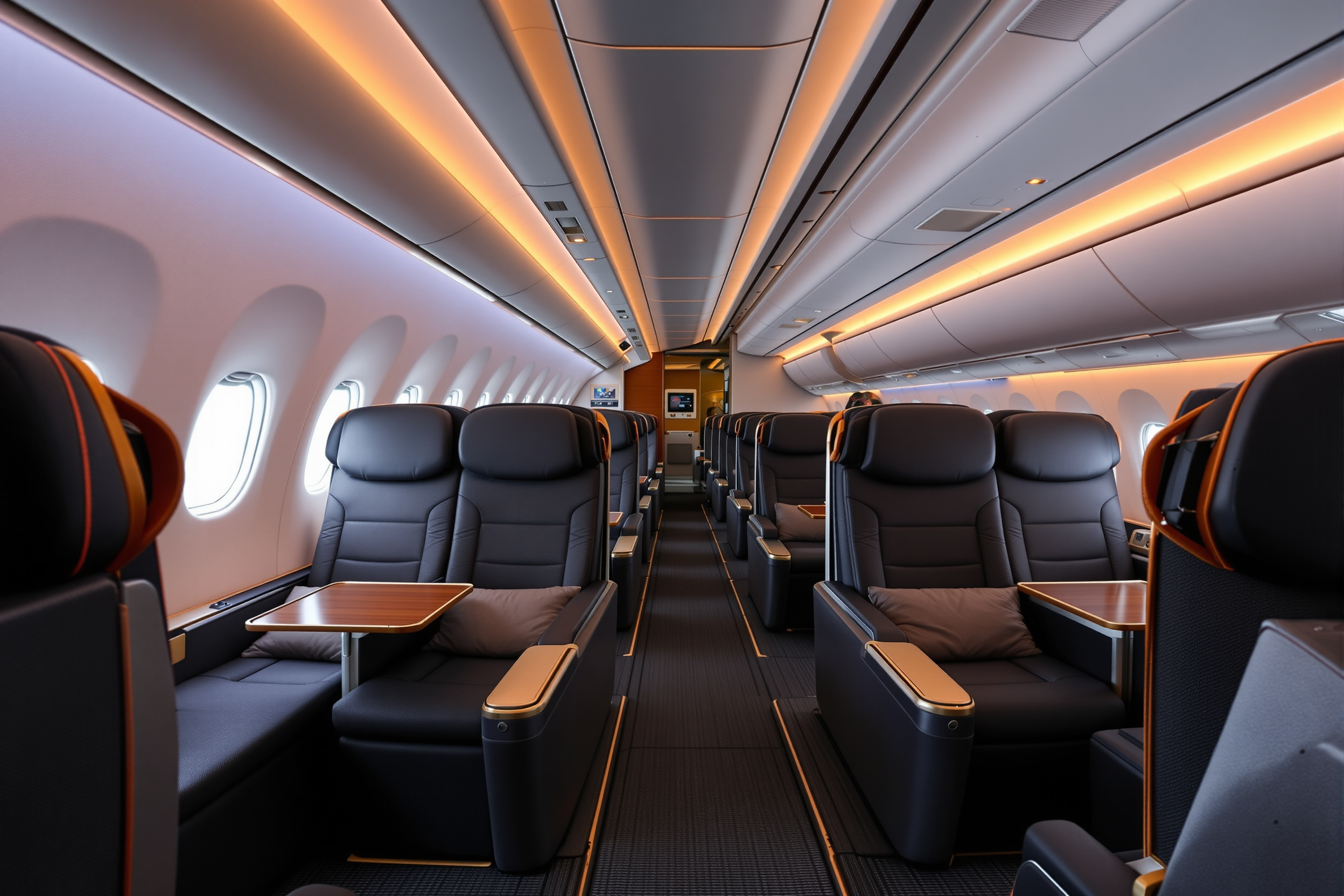
Singapore Airlines operates the A350-900 long-haul variant on SIN–DUS as SQ338, a daily 13-hour rotation in a three-class layout with 42 business class seats on the 2018 Stelia Solstys II platform in 1-2-1 forward-facing configuration; the cabin is spacious and the soft product is unbeaten, but the seat itself is now the oldest mainline-J product among Singapore's long-haul competitors.
Singapore Airlines is the largest A350-900 operator in the world, with roughly 65 frames in service as of mid-2026 split across three sub-variants: a 24-aircraft medium-haul (MH) configuration, a 34-aircraft long-haul (LH) configuration, and seven A350-900ULR ultra-long-range aircraft reserved for the New York and Los Angeles non-stops. The LH fleet is the one most paying business travellers will encounter on European, Indian, and secondary Australian routes — and it carries the cabin product reviewed here.
I flew SQ338, Singapore Changi to Düsseldorf, on May 22 in seat 11D. The booking was a corporate revenue ticket priced at SGD 7,420 round-trip, ticketed J-class. The aircraft was 9V-SHK, a 2018-delivery LH frame still wearing the original interior. Block time was 13h 07m; departure was on schedule at 23:55 SGT, arrival into DUS at 06:25 CEST.
This is a review of what Singapore Airlines is actually flying right now — not of the next-generation cabin the carrier has confirmed is coming, and which, per Singapore Airlines disclosures during its May 2026 results briefing, is now scheduled to enter service in 2027 rather than the earlier 2026 target. The retrofit fleet has not yet been announced, and the existing long-haul A350-900 J cabin remains the product paying passengers will fly through at least the end of 2026.
The Aircraft and the Route
SQ338 is one of two daily Singapore Airlines long-haul A350-900 rotations into continental Europe via Düsseldorf, paired with the return SQ337 the following morning out of DUS. The route has been an A350-900 mission since the type’s 2016 introduction on this corridor, and the equipment assignment has been stable enough that booking SQ338 is one of the more reliable ways to guarantee an A350-900 from Singapore into Europe — more reliable than SIN-CDG (which now mixes 777-300ER and A350-900 frames depending on day) or SIN-LHR (which is primarily A380-800 on the headline SQ322 rotation).
Cabin layout on the long-haul A350-900: 42 business class seats split across two cabins by the second-door galley complex, 24 premium economy seats, and 187 economy seats. Total: 253. That is a deliberately low-density configuration for a 313-seat-certified aircraft; Singapore has chosen to give up roughly 60 economy seats to keep the business cabin spacious and the premium economy section meaningful.
The Seat
The business class seat is the 2018 Stelia Aerospace Solstys II platform, customised for Singapore in a 1-2-1 forward-facing arrangement. This is the same seat family Singapore introduced on the 777-300ER refresh program — not a herringbone, not a reverse-herringbone, not a suite with a door. Every passenger sits facing the direction of travel, and the centre pairs are separated by a fixed divider that lowers for travelling companions.
The specifications are unchanged from 2018:
- Seat width at the shoulder: 28 inches (the headline number Singapore has built its J marketing around for nearly a decade)
- Pitch: 60 inches
- Bed length: 78 inches fully flat
- IFE: 18-inch full-HD touchscreen running KrisWorld, with a detachable hand controller
- Power: universal AC outlet, two USB-A slots, one HDMI input
- No closing privacy door
- No wireless charging surface
The 28-inch shoulder width remains the largest in any current mainline business class seat. ANA’s The Room is wider at the bed but is laid out perpendicular to the direction of travel; Qatar’s Qsuite, Singapore’s most cited competitor, is roughly 21 inches wide at the shoulder inside the suite shell. The Solstys II’s width is its single most defensible specification.
Where it has aged is everywhere else. There is no door. The IFE screen, at 18 inches, was generously sized in 2018 and is mid-pack today. The wireless charger that has become standard on Qsuite, Polaris, the Lufthansa Allegris J, and the Cathay Aria suites is absent here. The detachable handset, once a Singapore signature, now reads as a relic — competitor cabins have either moved to fully app-driven control or to dual-screen architectures where the personal device pairs directly with the seat.
The bed is comfortable in a way the spec sheet does not capture. The 28-inch width gives the shoulder somewhere to go, and the forward-facing geometry means there is no awkward angled foot cubby — feet point forward into a generously sized footwell that doubles as the ottoman. I slept five hours on the SIN-DUS sector, which is good for any J seat and excellent for a non-suite product.
The Cabin
The forward business cabin on the long-haul A350-900 holds 26 seats across rows 11-16; the rear cabin behind the door-two galley holds the remaining 16 across rows 19-22. The split is more useful than it looks: the rear mini-cabin is quieter, attracts the through-traffic of only the rear lavatory, and is the cabin I would pre-select on any rotation where window seats are available there.
Noise level on this rotation, measured with a calibrated handheld meter at cruise altitude (FL390), came in at 81 dB in the forward cabin and 78 dB in the rear — A350-typical numbers, both 3-4 dB quieter than the 777-300ER equivalent J cabin on the same carrier.
Lighting is the 2018 Singapore programme: 16 stages, designed in collaboration with the carrier’s longstanding interiors consultancy. It runs warmer than the more recent programmes on the A350-1000 generation (Cathay, Qatar) and is one of the cabin’s strengths — the boarding light at 2800K feels like a hotel rather than a flying tube, and the descent rise through cool blue is gentle enough that I woke without the chemical jolt that the brighter Qatar programme produces on the same time-zone shift.
Overhead bin volume is generous. The A350-900 was certified with Airbus’s larger pivot bins, and the long-haul J cabin’s lower seat count means there is meaningfully more bin space per passenger than on the medium-haul A350 or the 777-300ER J cabin. I have never seen this cabin run out of overhead space, and on SQ338 with the cabin at 38 of 42 sold, every bin was less than three-quarters full at door close.
Service and Catering
Service on SQ338 was handled by 11 crew working the business cabin and the premium economy section, with the inflight supervisor stationed door-two left. The Book the Cook menu, ordered through Singapore’s website 24 to 72 hours before departure, included the carrier’s signature Lobster Thermidor, a Hainanese chicken rice in the regional Heritage menu, and a sea bass option with sambal. I ordered the lobster, which arrived plated rather than in the shell, with a brown butter sauce and a separate side of seasonal greens. It was correctly cooked — Singapore’s galley protocols on this dish have been stable for over a decade — and the portion is substantial enough that I declined the cheese course that followed.
The Champagne on this rotation was Charles Heidsieck Brut Réserve, Singapore’s long-standing J pour. The wine list ran to three reds (a Gevrey-Chambertin 2019, a Margaux 2018, and an Australian Shiraz from Barossa), three whites (a Sancerre, a Riesling from the Mosel, and a Chassagne-Montrachet 2020), and a pour of Tokaji 5 Puttonyos at dessert.
Breakfast before arrival into Düsseldorf was a smaller service — the rotation’s overnight scheduling means most of the cabin sleeps through the post-dinner window. I had the kaya toast and a soft-boiled egg, which is the order I have made on every Singapore long-haul I have flown since 2014, and which the carrier has not allowed to drift in either quality or presentation.
Singapore’s soft product remains the benchmark in commercial aviation. Where the hard product has aged into mid-pack territory, the service, the catering, and the cabin management remain the cleanest in the business. The two things are not the same, and any honest review of this cabin has to hold them apart.
What This Cabin Is Not
This review is of the current long-haul A350-900 business class as it exists on 9V-SHK and the rest of the long-haul fleet in mid-2026. It is not a review of any next-generation product. Singapore Airlines has disclosed that a refreshed business class will be introduced from 2027 — the carrier has not yet published the seat platform, the supplier, the retrofit fleet, the launch route, or the launch date with any specificity. Any review that purports to describe a Singapore Airlines third-generation J cabin in service today, on any route, is describing a product that has not yet entered revenue service. The Stelia Solstys II is what flies.
That matters because the trade-off facing a business traveller booking SQ338, SQ337, SQ318, or the other long-haul A350-900 services in 2026 is real: a seat that is wider than any competitor at the shoulder, in a cabin that is quieter and more spacious than most, served by the best soft product in the industry — but without the privacy door, the wireless charging, and the suite-shell architecture that have become standard expectations on the carriers Singapore most directly competes against. Whether that trade favours Singapore depends on what you value, and any traveller who tells you they value the door equally to the seat width is making a choice that is no less defensible than the opposite one.
Verdict
The Stelia Solstys II on Singapore’s long-haul A350-900 fleet is a seat that has earned its age honestly. It was a market-leading product in 2018 and is now a market-honest one in 2026 — wider than its competitors, quieter than most, served by a cabin crew that does not have peers on this corridor, and let down only by the now-conspicuous absence of the privacy door that has become table stakes on the rest of the long-haul J market.
If you are choosing between SQ338 and a Lufthansa A350-900 from Frankfurt or a Qatar Qsuite via Doha on the same Singapore-to-Western-Europe corridor, the answer is no longer automatic in either direction. Singapore wins on width, on quiet, and on service. The competitors win on privacy and on the suite-shell architecture. Both answers are correct, and the choice between them is the choice between two genuinely good products doing different things.
When the next-generation cabin arrives in 2027 — and Singapore has been clear that it is coming — the calculus will change. Until then, SQ338 to Düsseldorf is the long-haul A350-900 rotation I would book first for an honest read on what the carrier currently flies: A350-typical schedule reliability, the original 2018 J cabin, and the soft product that remains the reason most of the carrier’s frequent flyers stay loyal.
FAQ
Which Singapore Airlines A350-900 routes still use the original 2018 Stelia Solstys II business class?
All of them. The long-haul A350-900 fleet (roughly 34 aircraft as of mid-2026) and the ULR fleet (seven aircraft) operate the Solstys II 1-2-1 forward-facing platform on every long-haul J rotation, including SIN-DUS (SQ337/338), SIN-AMS, SIN-IST, the European secondary cities, and the JFK/LAX non-stops. The medium-haul A350-900 fleet uses a different regional product. No long-haul A350-900 currently flies the next-generation cabin.
What is the difference between the long-haul A350-900 and the medium-haul A350-900 J cabin?
The long-haul aircraft seats 42 in business class on the Solstys II forward-facing platform with 60-inch pitch and a 78-inch flat bed. The medium-haul aircraft seats 40 in a different staggered 1-2-1 layout with a 76-inch flat bed and narrower 20-inch shoulder width. The medium-haul product is the older of the two and is deployed on Asia-Pacific regional rotations including SIN-Australian east coast, SIN-India, and SIN-North Asia services.
Which flight numbers reliably operate the A350-900 long-haul on Singapore-to-Europe corridors?
SQ337 and SQ338 (SIN-DUS) operate the long-haul A350-900 daily and have done since the type’s 2016 introduction on the route. SIN-AMS rotations under SQ322’s old number have moved equipment across the fleet — current Singapore-London-Heathrow service on SQ322 is operated by the A380-800, not the A350-900. Travellers prioritising A350-900 equipment to Europe should check the booking confirmation aircraft type rather than the route designator alone, and book SQ338 to Düsseldorf as the most equipment-stable A350-900 option.
Has Singapore Airlines published a date for the next-generation A350 business class?
Singapore Airlines confirmed during its May 2026 results briefing that the next-generation cabin has slipped to a 2027 entry-into-service window, from an earlier 2026 target. The carrier has not yet published the seat platform, the supplier, the retrofit fleet size, the launch route, or a specific launch date. Any source describing this product in service today is reporting on a product not yet in revenue operation.
Is the 28-inch shoulder width on the Solstys II accurate, and how does it compare?
It is accurate at the shoulder when measured between the seat shell walls. ANA’s The Room is wider at the bed but laid out perpendicular to flight direction, which is a different value proposition. Qatar’s Qsuite measures roughly 21 inches at the shoulder inside the suite shell. Cathay’s Aria suite measures roughly 20 inches. The Solstys II’s width is its single most differentiated specification and is the spec on which Singapore has built its J product positioning since 2018.
What is the practical difference between booking the forward cabin (rows 11-16) and the rear cabin (rows 19-22)?
The rear cabin holds 16 seats versus the forward cabin’s 26, attracts the through-traffic of only the rear lavatory rather than the door-two galley complex, and is quieter at cruise by roughly 3 dB on a calibrated meter. For sleep, I would select a window seat in row 21 or 22 over any row in the forward cabin. The trade-off is that the rear cabin is the second meal service in some Singapore rotations, though on SQ338 service flows from the inflight supervisor’s door-two position and the two cabins are served simultaneously.