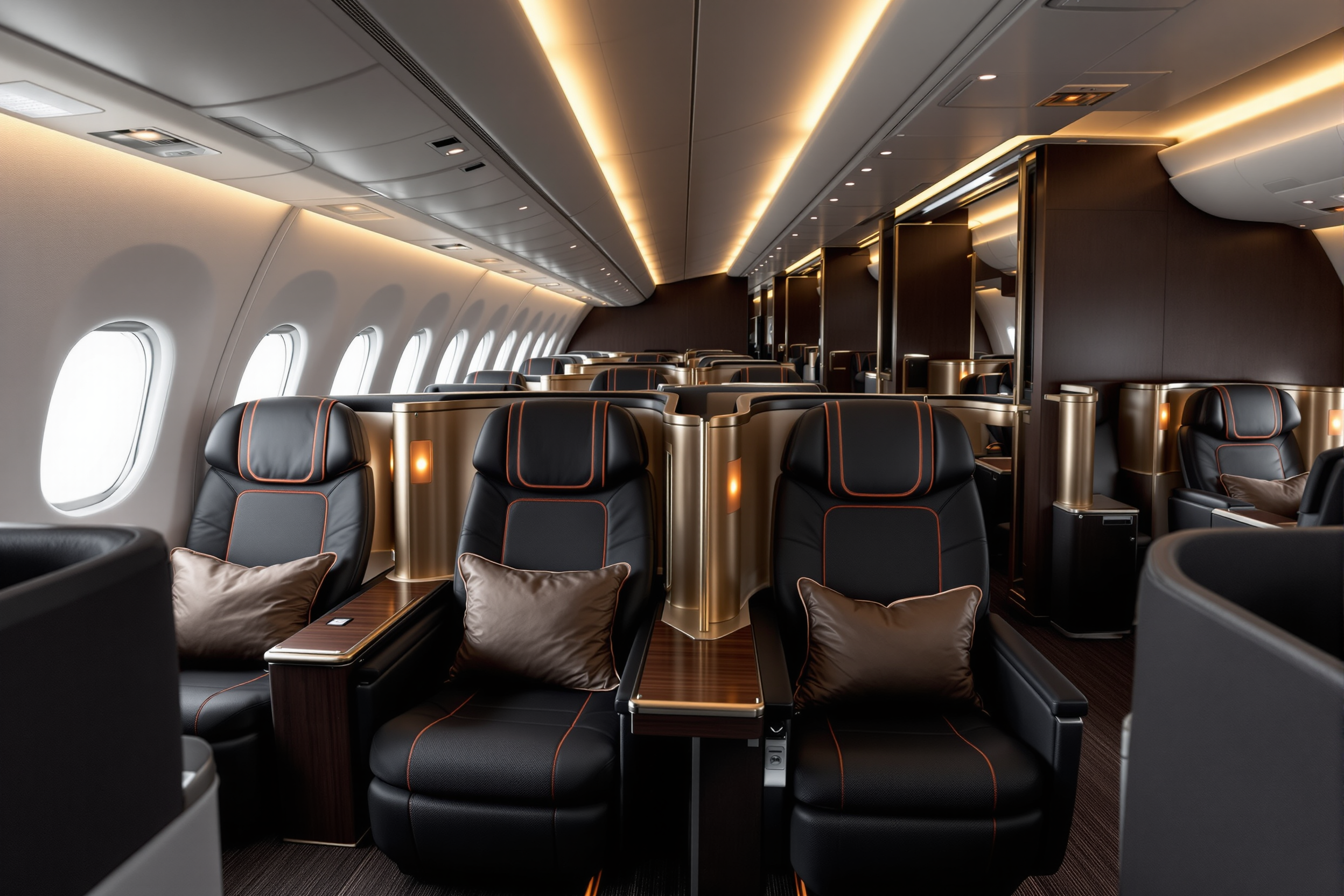
American Airlines is restoring a lie-flat business cabin on JFK–LAX and JFK–SFO using newly delivered Airbus A321XLR aircraft (155 seats: 20 Flagship Suites, 12 Premium Economy, 123 Main Cabin). The 17 legacy A321T airframes are being reconfigured to a 102-seat domestic two-class layout, not upgraded. American expects roughly 15 A321XLRs in fleet by year-end 2026, gating both the JFK–LAX ramp from December 2025 and the international debut on JFK–Edinburgh on March 8, 2026.
American Airlines is restoring a true lie-flat business cabin to its New York transcon and thin long-haul franchise, and the mechanism is not the one the trade press initially described. The carrier is not retrofitting its existing domestic Airbus A321neo fleet, and it is not refurbishing the legacy 17-aircraft Airbus A321T sub-fleet it withdrew from premium service in 2023. Instead, American is deploying newly delivered Airbus A321XLR aircraft — a different airframe, with a different mission, configured from delivery in a three-class layout of 20 Flagship Suites, 12 Premium Economy seats and 123 Main Cabin seats for 155 total. The first A321XLR entered service on JFK–LAX in December 2025, the type begins flying internationally on March 8, 2026 with the launch of JFK–Edinburgh, and additional transcon and thin transatlantic segments will turn on through 2026 as Airbus continues to deliver.
For corporate travel managers, the practical implication is that the recovery of American’s premium transcon product is gated by aircraft delivery cadence, not by retrofit engineering hours. That changes how the 2027 contracting cycle should be modeled, how seat-availability assumptions should be drawn for JFK–LAX and JFK–SFO, and how the legacy A321T fleet should be priced in capacity forecasts. The 17 A321Ts are going the other way: each one is being reconfigured to a standard domestic two-class A321 layout that adds approximately 88 seats and removes both the Flagship First and Flagship Business cabins. The premium transcon recovery and the A321T reconfiguration are running in parallel, but they are not the same project.
What American Is Actually Doing
American’s narrative through the back half of 2025 was that the carrier had a “premium gap” on its highest-yielding domestic routes — JFK–LAX and JFK–SFO — and that the answer was Flagship Suite, the lie-flat product the airline had unveiled for its 787-9 and 777-300ER refresh. The market initially read that as a retrofit story: a fleet of existing A321neos, pulled into a shop and rebuilt with lie-flat hardware, redeployed onto the same JFK transcon rotations the A321T used to operate. That reading was wrong on the hardware and wrong on the timeline.
The actual sequence is straightforward. American holds a current order for 40 A321XLR aircraft, trimmed from an original 50, of which Airbus has delivered the first units and is expected to deliver approximately 10 more in 2026. By year-end 2026, American expects roughly 15 A321XLRs in service. Each aircraft arrives from Hamburg in a single, factory-installed configuration: 20 Flagship Suites, 12 Premium Economy and 123 Main Cabin. American is not modifying an existing airframe to produce these seats; it is taking delivery of new aircraft that were specified, ordered and built for this role.
The first revenue flight operated JFK–LAX on December 18, 2025, after a slip from the original autumn target. American is selling the type on JFK–LAX through 2026 and has confirmed it will replace the remaining A321T premium transcon flying on that corridor as deliveries arrive. The JFK–SFO redeployment follows in 2026 on a schedule the carrier has not finalized in published timetables; Boston–LAX, the third leg of the original A321T transcon triangle, is also in the announced rollout. The international debut comes on March 8, 2026, when American launches daily seasonal JFK–Edinburgh service, the first long-haul international route American has operated with the A321XLR. That route runs through October 24, 2026 in the initial season and is complementary to the existing Philadelphia–Edinburgh service American has flown widebody.
Henry Harteveldt, principal at Atmosphere Research, has framed the A321XLR shift as both a product and a network play. The aircraft, he has argued, lets American compete in premium-heavy domestic corridors where the carrier had ceded ground to Delta One on JFK–LAX and to JetBlue Mint on JFK–SFO, while also opening thinner transatlantic markets that don’t support a widebody but do support a lie-flat narrowbody priced at premium-leisure yields. Bob Mann of R.W. Mann & Co., who has tracked American’s transcon strategy since the original A321T launch in 2014, has noted the operational symmetry: the same airframe that fixes the lie-flat gap on JFK–LAX is the one that justifies new transatlantic dots from JFK and PHL.
What American is not doing is equally important to state plainly. American is not retrofitting any of the approximately 220 A321neos in its domestic fleet to install Flagship Suite. It is not retrofitting the 17 A321Ts to a refreshed lie-flat cabin. It is not bringing back the Flagship First cabin in any form on a narrowbody. Travel managers planning around the 2027 contract cycle should disregard any version of the story that hinges on a retrofit timeline; the only timeline that matters is the A321XLR delivery cadence and the speed at which American can integrate the new aircraft into JFK rotations.
The Cabin Product
The Flagship Suite cabin on the A321XLR is anchored on the Collins Aerospace Aurora platform, a herringbone seat engineered to fit a single-aisle cross-section while still delivering a fully flat bed and direct aisle access for every seat. This is a different seat from the Elevate Aircraft Seating (formerly Adient Aerospace) Ascent reverse-herringbone product that American is rolling out on the 787-9 and the 777-300ER refresh. Both seats carry the Flagship Suite brand and both feature a sliding privacy door, but the platforms are not interchangeable and the in-suite footprints differ in ways that matter for storage, working surface and bed length.
In the A321XLR cabin specifically, each suite includes a 17-inch 4K touchscreen IFE display, a fixed side console with universal AC and a 60-watt USB-C outlet, wireless charging on a dedicated pad, and Bluetooth pairing for personal headphones. American has chosen to retain seatback IFE on this aircraft despite moving in the opposite direction on parts of its narrowbody refresh program — a signal, in our reading, that the carrier views the A321XLR cabin as a long-haul premium product whose customer expectations align more closely with the 787-9 than with a domestic A321neo. The 1-1 staggered geometry gives every suite a direct aisle path and a window without the over-shoulder reach that defines reverse-herringbone widebody cabins; the trade-off is a slightly narrower bed and reduced shoulder-level openness compared with the 787 product.
The Premium Economy cabin, 12 seats arranged 2-2, sits immediately behind the Flagship Suites. American has emphasized seat width, recliner travel and dedicated catering as the principal differentiators from extra-legroom Main Cabin, and the cabin is being sold as a discrete fare class on both transcon and transatlantic routings. Main Cabin, 123 seats in 3-3, occupies the rest of the airframe; American has described the seats as “reimagined” but has not published pitch numbers that diverge materially from the standard domestic A321neo. The total of 155 seats is materially lower than the approximately 196 seats American carries on a domestic-configured A321neo, which is the source of the unit-revenue case for redeploying the aircraft into premium-heavy corridors rather than running it as additional domestic gauge.
For a corporate buyer, the cabin matters in three specific ways. First, the suite-with-door product is competitive with Delta One Suites on JFK–LAX in cabin geometry, even if the storage and shoulder room favor the widebody product on Delta’s 767-400ER and A330-900 mainline transcon flying. Second, the Premium Economy cabin gives American a structured mid-tier on transcons for the first time — neither the A321T nor the domestic A321neo has carried a true Premium Economy product. Third, the IFE-plus-wireless-charging-plus-USB-C stack closes a hardware gap that had become a recurring complaint in corporate satisfaction surveys against United Polaris, where the equivalent narrowbody domestic transcon is on the 757-200 (United Premium Plus / Polaris) and the 737 MAX 9 (United First).
Route Plan and Sequencing
The A321XLR rollout breaks into two distinct sub-programs that share an airframe but have different network logics.
The domestic transcon sub-program begins with JFK–LAX, which American has been operating on the type since December 18, 2025. The carrier is selling the A321XLR on this route through 2026 and will transition additional rotations as deliveries arrive. JFK–SFO is next in the published sequence; American has not posted a firm date in revenue timetables but has signaled a 2026 turn-on as soon as a second pair of aircraft is available to anchor the rotation. Boston–LAX, which lost the lie-flat product in 2023 when American withdrew the A321T from JFK and BOS premium transcon flying, returns on the A321XLR in 2026 — again, on a schedule gated by aircraft availability rather than retrofit lines.
The international sub-program starts on March 8, 2026 with daily JFK–Edinburgh, a route American has not previously operated from JFK. Edinburgh is American’s first long-haul international A321XLR destination and the type’s first transatlantic deployment from the carrier. The economics are clear: Edinburgh is a thin market with a strong premium-leisure overlay, a tourism inbound that peaks in summer, and a corporate flow tied to financial services in Edinburgh’s New Town and the energy cluster in Aberdeen, accessible via Edinburgh on connecting carriers. A widebody would oversize the market in the shoulder seasons; the A321XLR sizes it exactly. American has signaled that additional thin transatlantic routes will follow from JFK and Philadelphia as deliveries continue, with the carrier’s networking team prioritizing markets where widebody economics break down but premium demand exists.
The schedule symmetry matters. American operates the A321XLR with the same aircraft type on transcon by day and transatlantic on overnights, allowing the carrier to flex aircraft into either market without changing crew bases or maintenance plans materially. The carrier’s prior experience with the A321T, which was JFK-resident and ran only domestic transcon, gives American a base of operational knowledge for crewing a narrowbody premium service from JFK — knowledge that will compound as the A321XLR fleet grows.
The competing premium-cabin capacity on JFK–LAX and JFK–SFO is what corporate buyers will be modeling. Delta operates Delta One on the JFK–LAX corridor with a mix of 767-400ER and A330-900 widebody mainline flying, plus 757-200 Premium Service rotations, and has held the market-share lead on premium revenue for the better part of three years. JetBlue operates Mint on both JFK–LAX and JFK–SFO with a mix of A321neo and A321LR aircraft, with the Mint Studio at the front and Mint suites in the main premium cabin. United operates Polaris widebody intermittently on JFK–LAX and 757-200 Premium Plus / Polaris on Newark transcons. American’s recovered Flagship Suite product slots into that competitive set as the only domestic-narrowbody three-class option with a fully flat suite door — a combination JetBlue’s Mint Studio approximates but does not match in scale.
Corporate Procurement Implications
The 2027 contracting cycle starts for most large U.S. corporates in October 2026, and the A321XLR ramp will be deep enough by then to make the recovered Flagship Suite product a real factor in transcon negotiations. The procurement question is not whether American can deliver a competitive lie-flat product — by Q4 2026 it will be selling one on the principal transcon corridor — but whether American can deliver enough of it.
The answer to that question runs through the delivery schedule. With roughly 15 A321XLRs expected in fleet by year-end 2026 and a ramp continuing through 2027, American will not have enough aircraft to staff JFK–LAX and JFK–SFO at the daily frequencies the legacy A321T flew in 2022 until well into 2027. That gap matters for share commitments. A travel manager who commits a large JFK–LAX volume to American on the assumption of an immediate Flagship Suite cabin across every rotation will be disappointed; for most of 2026, a meaningful share of American’s JFK–LAX rotations will continue to operate on the legacy A321T in its existing premium configuration, even as those airframes are progressively pulled offline for the downgrade to domestic two-class.
The mixed-gauge problem has three procurement implications. First, RFP language should specify aircraft type or product type, not just route — a JFK–LAX commitment that doesn’t distinguish between A321XLR Flagship Suite and A321T Flagship Business is committing capacity without committing product. Second, share targets should be ramped in line with the delivery schedule rather than set as flat year-one numbers, with explicit checkpoints tied to American’s quarterly disclosure of A321XLR fleet count. Third, expense-policy treatment of the recovered product should be reviewed: the lie-flat cabin on a sub-six-hour transcon shifts the policy question of “business class permitted” in ways that affect downstream spend.
Competitive benchmarking will tighten. Delta’s premium-cabin share on JFK–LAX has held above 30 percent of revenue for most of the last three years; JetBlue’s premium-cabin share on the same route is in the high teens. American’s recovery is not a market-share story in the abstract — it is a story about whether enough corporate volume shifts back from Delta and JetBlue to make the A321XLR deployment self-sustaining at the unit-revenue level Tom Fischer and other sell-side analysts have modeled. The honest answer is that the data won’t be visible in DOT T-100 segment statistics until late 2026 at the earliest, and corporate share commitments made in the 2027 cycle will be the leading indicator.
Ground-side capacity needs to be modeled too. JFK Terminal 8, American’s home terminal at JFK, was designed around widebody premium flow and has lounge capacity that has been progressively expanded for the Flagship Lounge and Flagship First Dining concepts. The recovered narrowbody Flagship Suite cabin sends more passengers through Flagship Lounge eligibility on a per-flight basis than the A321T did at peak, simply because the A321XLR carries twice as many suites as the A321T carried Flagship First seats. Lounge crowding during the JFK transcon morning bank and the transatlantic evening bank will be the operational pressure point through 2026.
Heather Garboden, American’s senior vice president and chief customer officer, has anchored the carrier’s public messaging around reliability and product consistency, and the 2026 American Customer Satisfaction Index showed American closing the gap with Delta to a single point year-over-year. The Flagship Suite restoration on the JFK transcons is the most visible product investment American can point to in that ACSI narrative, but the procurement reality is that customers will judge it on whether they can actually book the cabin on the rotations they need, not on whether it exists somewhere in the schedule.
The Legacy A321T Fleet
The 17-aircraft A321T sub-fleet is the part of this story most often misreported. The A321T airframes are not being retrofitted to lie-flat. They are being reconfigured downward — to American’s standard domestic A321 layout of approximately 20 first-class recliners, 35 extra-legroom seats and 135 Main Cabin seats, for a total around 190 seats per aircraft. That is approximately 88 more seats per airframe than the A321T’s prior 102-seat ultra-premium configuration of 10 Flagship First, 20 Flagship Business, 36 Main Cabin Extra and 36 standard Main Cabin.
American began the A321T conversion program in 2024 and is working through the fleet on a rolling basis. Flight schedule data show the carrier operating approximately 463 departures on the 102-seat A321T in January 2026, a 4 percent decline from January 2025 — consistent with a gradual rather than rapid reconfiguration cadence. The carrier has not published a specific date for the last A321T to exit premium configuration, but the program is expected to complete in line with the A321XLR delivery ramp through 2027.
The downgrade has three commercial consequences that interact with the A321XLR story. First, every A321T pulled offline for conversion is one fewer aircraft that can fly the legacy Flagship First / Flagship Business product, which means corporate buyers who have grandfathered relationships built around the 10 Flagship First seats lose that product entirely as the conversion progresses — and there is no replacement, because the A321XLR carries no Flagship First cabin. Second, the converted A321Ts will redeploy into standard domestic A321 missions, adding gauge to medium-haul routes that have been capacity-constrained — useful for American’s domestic network but not relevant to the JFK premium transcon story. Third, the conversion timeline gives American a natural backfill for any A321XLR delivery slips: if Airbus is late on a delivery, American can hold a finished A321T in premium configuration a quarter or two longer to bridge the schedule.
That bridging mechanism is part of why the recovered premium transcon product won’t look clean to corporate buyers in 2026. Some JFK–LAX rotations will operate on A321XLR. Some will continue on A321T in its existing premium configuration. As more A321XLRs deliver and more A321Ts are pulled for conversion, the mix will shift toward A321XLR, but the carrier will not flip the whole schedule on a single date. Travel managers tracking the product on day-of-departure aircraft assignments will see both types co-existing on the route through most of 2026.
The end-state, however, is unambiguous. Once the last A321T converts to domestic two-class, American’s JFK premium transcon flying — and its eligible thin transatlantic flying — will run exclusively on the A321XLR Flagship Suite product, with widebody backfill where the demand profile justifies it. That end-state is the one corporate buyers should be modeling against in the 2027 cycle, with delivery cadence as the binding constraint and the legacy A321T as a depreciating but useful bridge.
What to Watch
Three signals will tell the procurement market how this story unfolds.
First, the JFK–SFO turn-on date. American has signaled JFK–SFO as the second A321XLR domestic transcon corridor, and the date at which the type takes over the bulk of that flying will mark the point at which JetBlue Mint faces a direct lie-flat-with-door competitor on its strongest premium-cabin franchise.
Second, the JFK–Edinburgh load-factor and yield disclosure once American begins publishing 2026 Q1 and Q2 data. The Edinburgh route is the first real test of whether the A321XLR economics work on a thin transatlantic with a premium-leisure overlay. A successful Edinburgh season unlocks the broader thin-transatlantic strategy that has been the analyst case for the A321XLR all along.
Third, the cadence of Airbus deliveries. American has guided to approximately 15 A321XLRs in fleet by year-end 2026, but Airbus’s A321XLR delivery rate across its full backlog has been below initial expectations through 2025. Any further slippage moves the A321XLR-only end-state out by quarters, and extends the period during which corporate buyers will see mixed-gauge JFK transcon operations.
The premium transcon recovery is real. The recovery mechanism is new aircraft, not retrofits. The recovery timeline is delivery-bound, not engineering-bound. And the legacy A321T is going domestic, not coming back. Plan around that frame.
Frequently Asked Questions
- Is American retrofitting its existing A321neos or A321Ts to bring back lie-flat on transcons?
- No. The lie-flat product is returning on newly delivered Airbus A321XLR aircraft — a different airframe from both the domestic A321neo and the legacy A321T. The 17 A321Ts are being reconfigured downward to a standard domestic two-class layout (roughly 20 first-class recliners plus extra-legroom and standard economy), not upgraded. The domestic A321neo fleet is unchanged.
- How many seats are in each Flagship Suite cabin and how are they laid out?
- Twenty Flagship Suites in a 1-1 staggered, direct-aisle configuration, paired with 12 Premium Economy seats in a 2-2 arrangement and 123 Main Cabin seats — 155 seats total per A321XLR. Each suite has a sliding privacy door, lie-flat bed, 17-inch 4K touchscreen IFE, wireless charging, Bluetooth audio pairing and a 60-watt USB-C outlet.
- What is the route plan for the A321XLR through 2026?
- American debuted the A321XLR on JFK–LAX in December 2025 and is now selling the type on JFK–LAX through 2026. JFK–Edinburgh launches as the first international route on March 8, 2026. American has signaled JFK–SFO and Boston–LAX as the next domestic transcon segments, with additional thin transatlantic routes from JFK and Philadelphia to follow as deliveries arrive.
- How many A321XLRs will American actually have in service in 2026?
- American has guided to roughly 15 A321XLRs in fleet by the end of 2026, against a current order book of 40 aircraft (trimmed from an original 50). That delivery cadence — not retrofit scheduling — is the binding constraint on how quickly the lie-flat product can be deployed across both transcon and thin long-haul markets.
- What seat platform is American using on the A321XLR Flagship Suite?
- The A321XLR Flagship Suite is built on the Collins Aerospace Aurora platform, a herringbone seat designed for narrowbody widths. This is a different platform from the Elevate Aircraft Seating (formerly Adient Aerospace) Ascent reverse-herringbone seat being used in the 787-9 and 777-300ER Flagship Suite cabins. Both products carry the Flagship Suite brand but the hardware, suite footprint and storage geometry differ.
- How should corporate travel programs respond during the 2027 contracting cycle?
- Treat the A321XLR ramp as a capacity event, not a marketing event. Model premium-cabin seat-availability on JFK–LAX, JFK–SFO and BOS–LAX by month against the public delivery cadence, benchmark against Delta One, United Polaris/Premium Plus and JetBlue Mint, and tie any share commitments to American's actual gauge on the routes that matter to your travelers — not to fleetwide promises.